Integration should not mean erasure. How we help newcomers build a life in Canada while honouring the culture they brought with them.
Integration is too often spoken of as a one-way street: learn the language, adopt the customs, leave the rest behind. We reject that version. A woman who is asked to erase her culture to belong in a new country is not being integrated. She is being diminished. Both she and her new country are poorer for it. The rejection is not rhetorical. It is practical, and it shapes everything we do. We design our integration work as a two-way street, in which the newcomer learns the new country and the new country, through her, learns the world. The exchange is the integration, and the integration is the exchange.
Our integration work insists on a different path. We help newcomers navigate the practical landscape of Canadian life, healthcare, banking, schools, community systems, while honouring the rich cultures and traditions each woman brings. Integration, for us, means addition, not subtraction. The woman who arrives with a culture is not asked to set it down. She is asked to set it on the table, alongside the cultures already there, and to let the table become richer for the addition. The richer table is the Canada we are working to build, and every woman who brings her culture to it is a builder of that Canada.
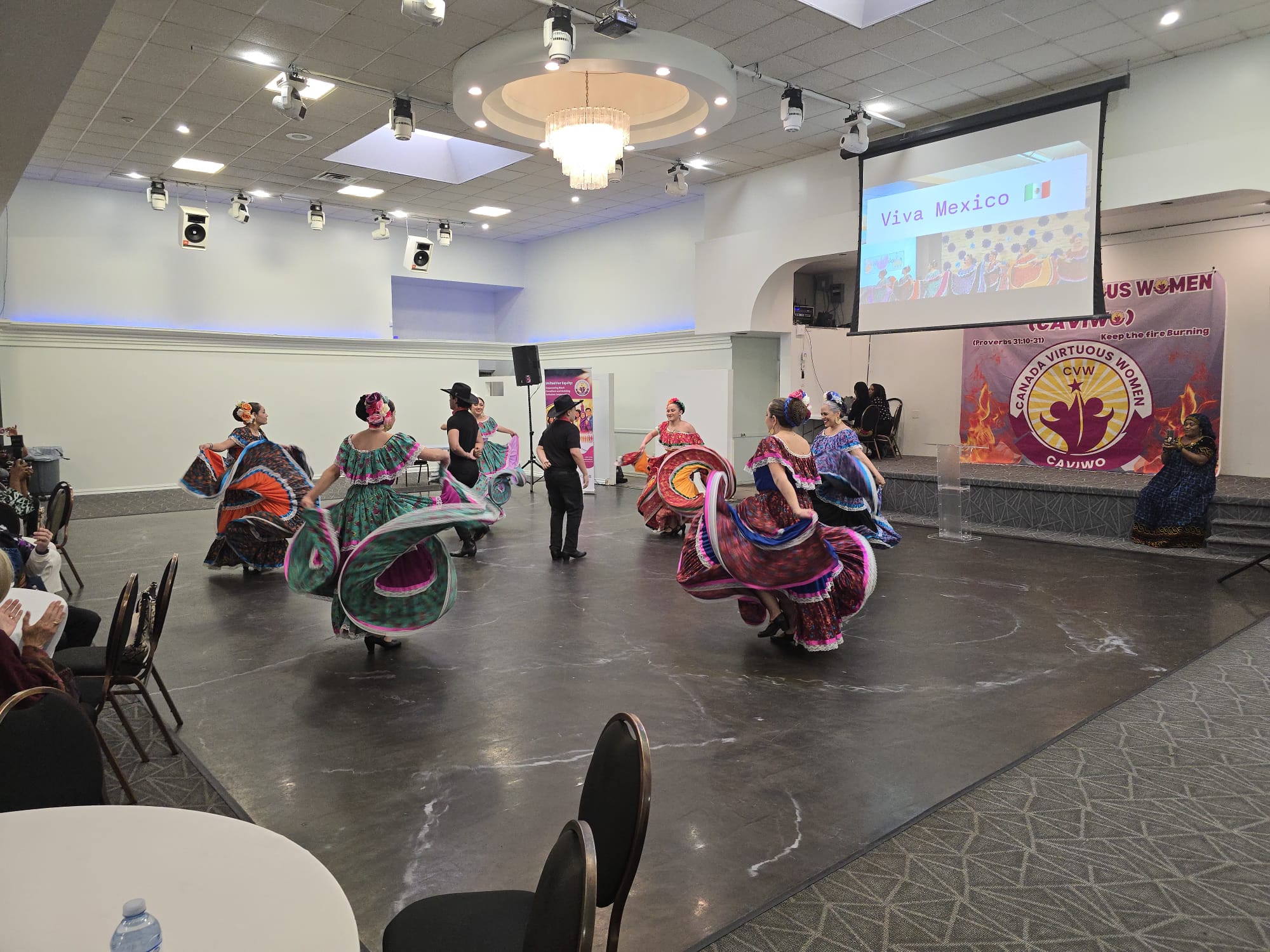
Our cultural heritage celebrations give women a stage to share their music, food, dress, and story with the wider community. Our intercultural exchanges build mutual understanding, not by flattening difference, but by celebrating it. The result is a community that is more, not less, because of its diversity. The celebrations are not performances for an audience. They are offerings from a community to itself, and the community that receives them is changed by the receiving, becoming more curious, more respectful, and more connected than it was before. The change is the point, and the celebration is the method.
We have learned that the honoring of culture is itself a form of integration, because a woman who is allowed to keep her culture does not need to choose between her old home and her new one. She brings both, and the bringing is what makes her belong. A woman who is asked to choose will always feel half at home, no matter how long she stays. A woman who is allowed to bring both will feel fully at home, often sooner than anyone expects. The permission to keep is the path to belonging, and we offer it deliberately, knowing that it is the foundation on which everything else is built.
One newcomer told us she had been told to soften her accent to be taken seriously. At our celebration, she read a poem in her mother tongue. The room did not understand the words. Everyone understood the pride. She told us it was the first time she had felt both Canadian and fully herself. That is the integration we are building. The pride in her own language did not diminish her Canadian belonging. It deepened it, because a woman who is allowed to be fully herself in a new country is a woman who can give fully of herself to that country, and the giving is what integration is ultimately about.
We also work with the receiving community, because integration is a two-way street and the receiving side has its own work to do. We offer cultural humility workshops for employers, service providers, and community groups, helping them understand the assets that newcomers bring rather than only the needs they present. The shift from seeing newcomers as burdens to seeing them as contributors is essential, and it does not happen by accident. We facilitate it, gently and persistently, because a receiving community that sees newcomers as contributors is a community that integrates them well, and a community that sees them as burdens integrates them poorly, no matter how good its intentions.
The children of newcomers are often the bridge between cultures, and we support them in that role. A child who learns the new language faster than her parents becomes the family's navigator, and the role is both a gift and a burden. We help families honor the child's role without overloading it, and we help the children maintain connection to their parents' culture even as they embrace the new one. The balance is delicate, and the children who achieve it become the most integrated members of their families and, often, the most effective ambassadors of their cultures to their new communities. We tend them carefully, because they are the future of the integration we are building.
We have learned that integration, done well, produces not assimilation but enrichment. A Canada that integrates well is a Canada that becomes more itself through the addition of every newcomer, not a Canada that makes every newcomer a copy of an existing self. The difference is profound, and it is the difference between a country that tolerates diversity and a country that is strengthened by it. We work for the second, and we measure our progress in the small signs that the second is being built: the employer who adjusts a practice to honor a newcomer's observance, the school that celebrates a child's heritage, the neighbor who learns a greeting in a new language.
The work is slow, and the setbacks are real. There are days when the one-way version of integration feels ascendant, when the pressure to erase is loud, when the celebration of difference is met with suspicion. On those days, we return to the table, to the dinners, to the celebrations, and we remember that the integration we are building is not the work of a season but of a generation, and that the generation that builds it will leave to the next a Canada that is richer, kinder, and more truly itself than the one it inherited. That is the vision, and the table is where we build it, one meal, one story, one culture at a time.
If you are a newcomer who has felt the pressure to leave yourself behind in order to belong, we want you to know that the pressure is wrong and that there is a community that will receive you whole. Bring your language. Bring your food. Bring your music, your faith, your story, your pride. The table is richer when you bring all of it, and the Canada we are building together is the Canada that has always been possible but has never been fully realized: a country where everyone fits, fully, without erasure, and where the belonging is built on the honoring rather than the abandoning of who you are.
There is a workshop we run within this program that we have come to see as transformative, and it is the workshop on the bilingual home. We help newcomer families understand that raising children in two languages is not a disadvantage but a gift, and we provide the practical strategies that make the bilingual home sustainable. The workshop was born from a concern we heard repeatedly, that parents were abandoning their home language out of fear that it would confuse their children or slow their integration. We bring the research, which is unambiguous, that bilingualism is an asset, and we bring the community, which is full of bilingual families who have thrived. A family that leaves the workshop committed to keeping their language alive in their home leaves with more than a strategy. They leave with the permission to preserve the thing that connects their children to their grandparents, their heritage, and their history, and the permission is what ensures that the culture is carried, not erased, into the next generation.
We have also learned that the women who carry their culture most proudly into their new country are often the women who integrate most successfully, because the pride is itself a form of confidence, and confidence, in any culture, is attractive. A woman who walks into a room certain of who she is invites the room to meet her at her full height, and the meeting, at full height, is the beginning of a mutual respect that no apologetic integration could produce. We nurture the pride, not as chauvinism but as self-knowledge, because we have learned that a woman who knows who she is can become who she wants to be, in any country, and the becoming is the integration that lasts.
There is a particular challenge in this work that we hold with honesty and care, and it is the challenge of the second generation, the children who are born in Canada to newcomer parents and who navigate, their whole lives, the space between two cultures. We support these young people, because we know that the navigation is complex and that the support of a community that understands both cultures can make the difference between a fractured identity and an integrated one. We create spaces where second-generation youth can explore the questions they carry, about belonging, about identity, about the country they were born in and the country their parents came from, and we hold the questions without rushing the answers, because the answers, for these young people, are not given but grown, and the growing is the work of a lifetime. The young people who find that support become, often, the most effective bridge-builders in their communities, and we are honored to walk with them as they build.
We measure the fruit of this work in the women who carry their culture with pride, in the families that raise bilingual children, in the second-generation youth who build bridges, and in the Canada that is being built, one carried culture at a time, into the country it has always aspired to be. The building is slow, and the setbacks are real, but the fruit is visible in every celebration, every bilingual home, every young person who stands confidently in the space between two cultures and calls it home. We carry the work with joy, because the joy is the point, and because the Canada we are building is a Canada worth building, and the building is the work we are given to do.
Written by
CAVIWO Integration Team
Contributor to the CAVIWO community sharing stories of hope, resilience, and advocacy.