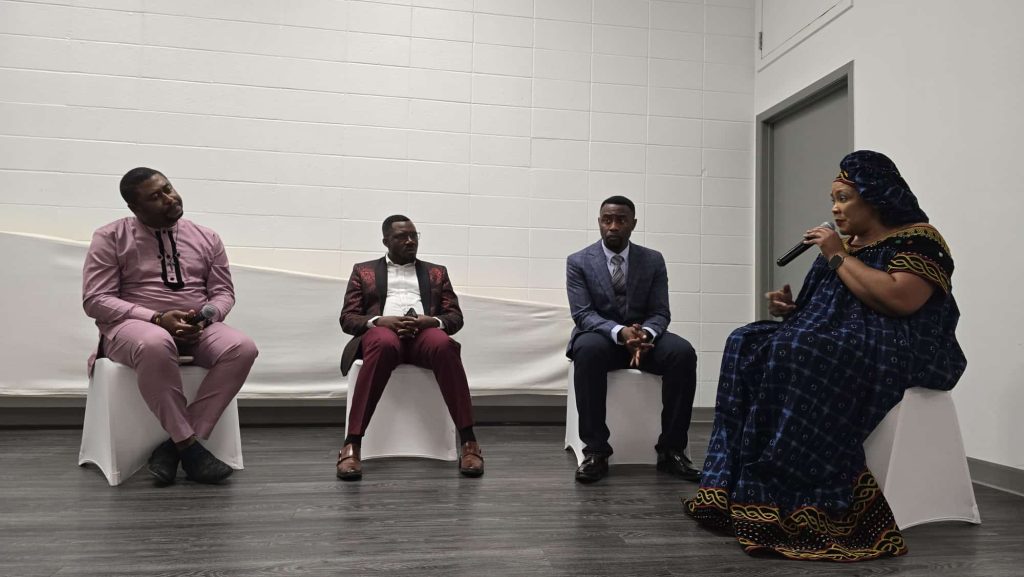
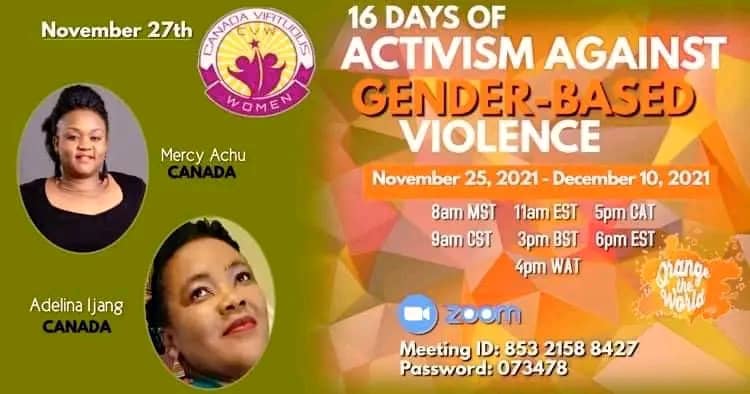
On Saturday, November 27th, 2021, CAVIWO convened a virtual gathering to navigate the way forward for victims of gender-based violence, as part of the global 16 Days of Activism campaign. The session brought together women across continents to share strategies, stories, and solidarity in the fight against GBV.
On Saturday, November 27th, 2021, Canada Virtuous Women (CAVIWO) convened a powerful virtual gathering as part of the global 16 Days of Activism against Gender-Based Violence. The session, held at 11:00 AM EST (5:00 PM West African time), brought together women, advocates, and allies across continents to navigate the way forward for victims of gender-based violence. It was a moment of convergence, where lived experience, professional expertise, and community wisdom met in a shared space to chart a path toward safety, justice, and healing.
The timing was significant. The 16 Days of Activism, running annually from November 25th, the International Day for the Elimination of Violence against Women, through December 10th, Human Rights Day, is one of the most important periods in the global advocacy calendar. CAVIWO chose to anchor its contribution on day three of the campaign, ensuring that the conversation began early and that the momentum built would carry through the remaining days and beyond. The theme of the session was clear and urgent: navigating the way forward against gender-based violence, with a focus on the women who are most affected and the systems that must change.
The virtual format was deliberate. By hosting the session online, CAVIWO ensured that women who could not travel, who could not afford to attend, who were in remote communities, or who could not safely appear in public, could still participate fully. The Zoom platform became a bridge across geography, language, and circumstance, connecting women in Ottawa with women in West and Central Africa, and with allies around the world. The accessibility was not incidental. It was a statement that the women who need this conversation most are often the women who face the greatest barriers to participating in it, and that removing those barriers is itself an act of justice.
The session opened with a grounding in the reality of gender-based violence. The statistics are staggering and, behind every statistic, a woman with a name and a story. One in three women worldwide will experience physical or sexual violence in her lifetime. In some regions, the numbers are higher. The violence crosses every boundary of class, culture, age, and geography, but it does not land evenly. Women of African and Caribbean descent, newcomer and immigrant women, women living with disability, women in rural communities, and women living in poverty face compounded risks and compounded barriers to seeking help. The session named these realities plainly, because a conversation that does not name the most affected is a conversation that cannot serve them.
The discussion moved through several key themes, each grounded in the voices and experiences of the participants. The first theme was the journey from victim to victor, a framing that honors the agency of women who have survived violence without minimizing the harm done to them. A victim is not a identity. It is a circumstance. A victor is not a denial of suffering. It is a declaration that the suffering will not have the last word. The women who shared their stories during the session demonstrated this transition in real time, naming what was done to them, claiming what they have built despite it, and offering their hard-won wisdom to others still navigating the early stages of the journey.
The second theme was the importance of community and collective action. Gender-based violence thrives in isolation. It depends on a woman believing she is alone, that no one will believe her, that what is happening is somehow her fault. The session dismantled that isolation by bringing women together, by creating a space where stories were heard and believed, and by reminding every participant that the work of ending violence is a shared responsibility. No single organization, no single government, no single community can end GBV alone. The collaboration across sectors, across borders, and across cultures is not optional. It is essential.
The third theme was the role of faith and spiritual community in the work of healing and prevention. CAVIWO's foundation is rooted in biblical principles of compassion, justice, and the inherent dignity of every woman. The session explored how faith communities can be safe spaces for survivors, how spiritual leaders can be trained to respond to disclosures of violence with belief and practical help, and how the message that abuse is never the victim's fault can be carried from the pulpit into the pews. The faith dimension was not a replacement for professional services. It was a complement, a source of strength and resilience that sustains women through the long road of healing.
The fourth theme was the need for systemic and policy change. Individual support, while essential, is not sufficient if the systems that surround women remain unchanged. The discussion addressed the need for stronger legal protections, better-funded shelters, culturally appropriate counseling services, and accountability for perpetrators. Participants shared their experiences navigating systems that too often re-traumatize the women they are meant to help, and the session called for a rethinking of how services are designed and delivered, with the voices of survivors at the center of the design.
The fifth theme was the particular vulnerability of newcomer and immigrant women. Women who have left their countries of origin, who are building new lives in Canada, often face violence without the safety net of family, community, and language. They may not know their rights, may not trust institutions, may fear deportation, and may be isolated by cultural and linguistic barriers. The session highlighted the work CAVIWO does to reach these women, to provide information in accessible formats, to build trust through consistent presence, and to connect them with services that respect their dignity and their circumstances.
The sixth theme was the engagement of men and boys in the work of ending gender-based violence. The session acknowledged that while women are the primary victims, the work of prevention must include men as allies, as educators, and as agents of change in their own communities. The conversation explored how to invite men into the work without centering them, how to hold men accountable without alienating them, and how to build cultures where healthy masculinity includes the rejection of violence in all its forms.
Throughout the session, the energy was a balance of grief and hope. There was grief for the women who have been lost, for the women who are still in danger, for the systems that have failed, and for the long road that remains. There was hope in the women who showed up, in the stories of survival and resilience, in the commitment to continue the work, and in the belief that change is possible when women stand together. The session did not pretend that the work is easy or that it is close to finished. It honored the difficulty while insisting on the possibility, and the insistence is what carries the work forward.
CAVIWO committed, at the close of the session, to several concrete actions. The organization pledged to continue its survivor support programs, to expand its digital safety education, to strengthen its partnerships with shelters and legal clinics, and to advocate for policy changes that center the most vulnerable women. The organization also committed to continuing the conversation, to hosting future sessions, and to ensuring that the women who participated would remain connected to the community and to each other beyond the 16 days.
The session was broadcast live on Facebook through the HOPE FOR HER GLOBAL PAGE, and the Zoom link was shared widely through CAVIWO's networks. The dual channels ensured that women who could not join the video call could still follow the conversation and participate through comments and messages. The accessibility was part of the message. If the conversation about ending violence against women is not accessible to the women most affected by it, the conversation has not yet reached its purpose.
As the 16 Days of Activism continued toward December 10th, the momentum from this session carried forward. The women who participated left with new connections, new resources, and a renewed sense of purpose. The advocates who facilitated left with a deeper understanding of the needs and the strengths of the community. The organization left with a clearer roadmap for the year ahead, informed by the voices of the women it serves. The session was a beginning, not an end, and the work it launched will continue through every season, in every community, until the day when no woman fears violence in her home, her workplace, her community, or her screen.
To every woman who joined the session, who shared her story, who listened to another woman's story, who held space in silence and in speech, we say thank you. Your presence was the work. Your courage was the message. Your solidarity was the proof that the way forward is not a path we walk alone but a road we build together, step by step, woman by woman, community by community, until the road leads to a place where every woman is safe, every woman is believed, and every woman is free. That is the destination. That is the work. That is the promise of CAVIWO, and it is a promise we intend to keep.
Written by
CAVIWO Advocacy Team
Contributor to the CAVIWO community sharing stories of hope, resilience, and advocacy.