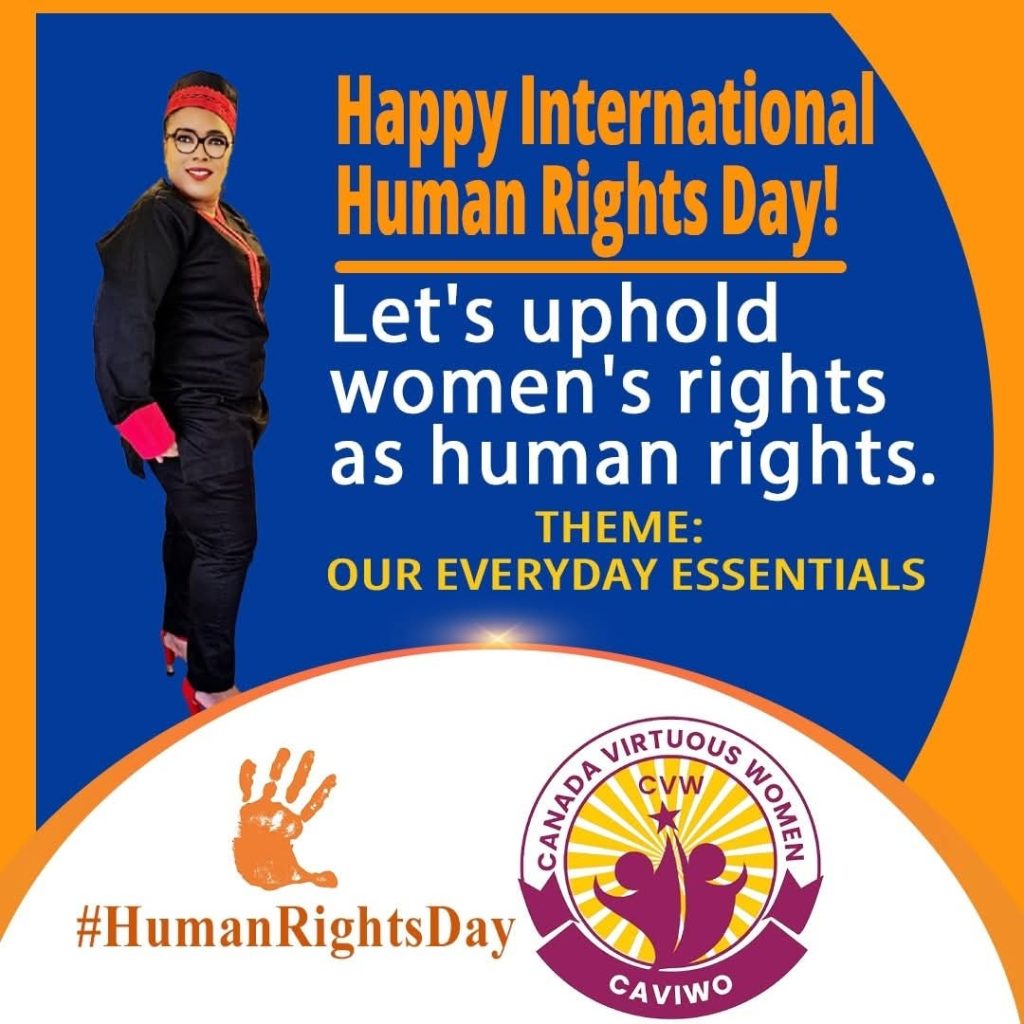
On December 10, 2025, CAVIWO joins the global community in celebrating International Human Rights Day under the United Nations theme, Our Everyday Essentials. Human rights are not just abstract legal concepts. They are the food on our tables, the safety of our homes, the education of our children, and the dignity with which we are treated by our neighbors.
On December 10, 2025, Canada Virtuous Women (CAVIWO) joins the global community in celebrating International Human Rights Day. This year, the United Nations has chosen a theme that resonates deeply with our mission and the work we do in our community: Our Everyday Essentials. The theme is an invitation to remember that human rights are not only discussed in courtrooms and legislatures. They are lived in kitchens, classrooms, workplaces, and neighborhoods, in the everyday conditions that allow a person to live with dignity and with security.
At CAVIWO, we believe that human rights are not just abstract legal concepts. They are the tangible realities of our daily lives. They are the food on our tables, the safety of our homes, the education of our children, and the dignity with which we are treated by our neighbors. When we speak of empowerment, we speak of these essentials, because a woman who cannot feed her family, who does not feel safe in her home, or who has been denied the chance to learn and to earn is a woman whose rights have been denied in the most practical sense. Our work begins where the abstract meets the ordinary.
What Everyday Essentials means to us is simple and grounded. The 2025 theme reminds us that human rights are the foundation of a stable and fulfilling life. For the women and families we serve, these essentials are the building blocks of empowerment, and we work to make them real, one woman, one family, one community at a time. We do not separate human rights from the rest of our mission. They are the frame within which every program we run takes its meaning.
The right to dignity is the first of these essentials. Every woman deserves to feel valued and respected, regardless of her background or her economic status. Dignity is not earned. It is owed. It is the baseline from which every other right becomes possible, because a woman who has been stripped of dignity has been stripped of the ground on which she would stand to claim the rest. We hold this right at the center of our work, and we hold it by name, because naming it is the first step in protecting it, and protecting it is the work of every program we run.
The right to security is the second. Providing a safe space for women to grow, to learn, and to heal is at the core of our mandate. For the women we serve, security is not a given. It is often the thing they have lacked the most, and the thing they need first. A woman who is not safe cannot plan, cannot learn, and cannot build. We create the spaces, the programs, and the community that make safety possible, and we do so because we know that without it, none of the other essentials can take root. Safety is not a privilege we offer. It is a right we help restore.
The right to opportunity is the third. Through our skills training and educational workshops, we work to make the right to work and to economic independence a reality for the women we serve. Opportunity is not a favor. It is a right, and a right that is not made accessible is a right in name only. We open the door to it with practical, culturally relevant training, with mentorship, and with the encouragement that reminds a woman that her skills and her experience have value in the world she is building for herself and her family. Economic independence is, for many of the women we serve, the most concrete form a human right can take.
Human rights start at home. Eleanor Roosevelt once asked, Where, after all, do universal human rights begin? In small places, close to home. Her words remain true. As we reflect on the theme of Everyday Essentials, we are reminded that protecting human rights is a collective responsibility. It begins in how we treat one another in our neighborhoods, our workplaces, and our schools. It begins in ensuring that the most vulnerable among us have access to the basics needed to thrive, and it continues in the quiet, daily decisions that either uphold or erode the dignity of the people around us. The small places are where the large commitments are kept or lost.
As we mark this important day, CAVIWO reaffirms its commitment to holistically empowering women and children. We pledge to continue working to ensure that the everyday essentials of dignity, safety, and hope are accessible to all, and we invite our community to walk alongside us in that work. The pledge is not a slogan. It is a continuation of the work we do every day, and the day gives us a moment to name it, to honor it, and to renew it together.
There are simple ways to participate today. Reflect on the everyday essentials you value most, and take a moment to name them. Act by checking in on a neighbor, by donating to a local food bank, or by sharing a message of support with someone who needs it. Engage by following our social channels, where we are highlighting stories of resilience and hope from our community. Each of these small acts is, in its own way, an act of human rights, because each one protects the dignity of a person who deserves to be seen.
Together, we can make human rights a reality for everyone, every day. Happy International Human Rights Day. For more information on our programs and how you can support our mission, please visit our donate page or contact us directly. We are grateful for every person who stands with us, and we look forward to another year of working, in small places and close to home, for the everyday essentials that make a life worth living.
Written by
CAVIWO Team
Contributor to the CAVIWO community sharing stories of hope, resilience, and advocacy.