Grief, poverty, and isolation can make a woman feel forgotten. Our support groups ensure she is seen, supported, and surrounded by community.
There are seasons in a woman's life when the world looks away. A woman in the first raw months of loss. A senior whose children have moved far away. A woman whose income has collapsed and who cannot bring herself to tell anyone. In these seasons, the cruelest part is not the hardship itself but the feeling of being forgotten. The forgetting is not always intentional. Often it is the natural drift of a world that moves on while a woman cannot. But the effect is the same, whether the forgetting is cruel or careless: a woman who was once known becomes invisible, and the invisibility compounds the hardship until the two are inseparable.
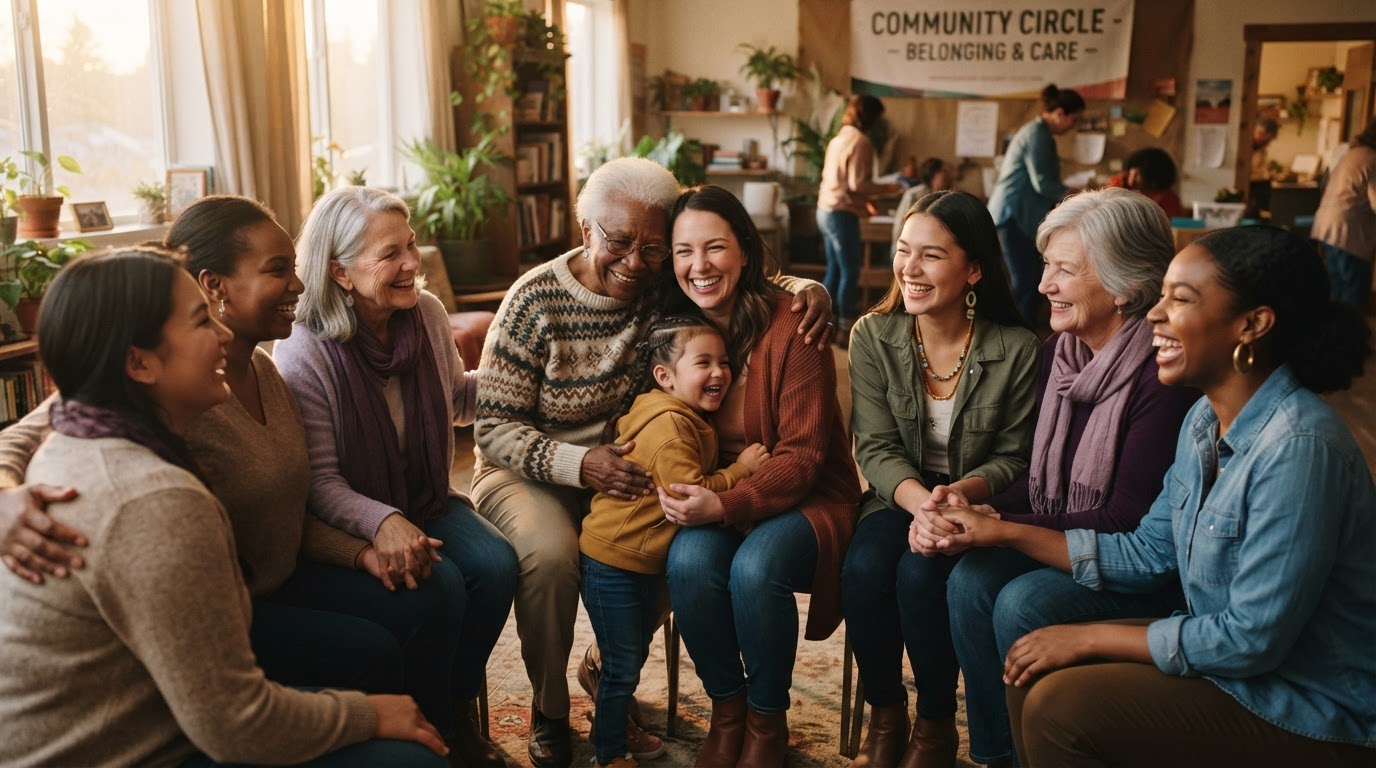
Our Women and Senior's Care program exists to refuse that forgetting. Our support groups gather women and seniors into circles where they are known by name, where their hardship is witnessed, and where they are surrounded by community that will not look away. The refusal is active, not passive. We do not simply wait for women to find us. We seek them out, in the seasons when they are least able to seek, and we carry the circle to them until they are able to carry themselves to it. The seeking is the work, and the work is what makes the refusal real.
The groups are practical and they are personal. We share information about resources, yes. But more than that, we share presence. A woman who has been alone too long needs to be reminded that she matters, and that reminder is best delivered in person, by people who keep showing up. The information about resources is essential, and we provide it thoroughly, but we have learned that the information is received differently when it is delivered in the context of relationship. A woman who is handed a brochure may never use it. A woman who is handed a brochure by a friend who will follow up uses it, and the difference is the relationship.
We have learned that the most important thing we offer is not any single resource but the consistency of our presence. A woman who has been let down by people who did not stay needs, above all, people who do stay, and the staying is what we promise and what we deliver. The groups meet regularly, the same women, the same time, the same place, and the regularity is the medicine. A woman who knows that on the first Thursday of every month she will be seen, by name, by people who have been coming for months, begins to plan her month around that Thursday, and the planning is the first sign that she is beginning to live again rather than merely endure.
One senior in our circle had not had a visitor in over a year when she joined. She told us the group was the first place in a long time where someone had asked how she was and waited for the answer. She has not missed a meeting since. She is not forgotten. None of them are. That is the work. The story is not unusual. The seniors we serve are often the most invisible members of our community, and the visibility we restore is, for them, a return to the world of the living. The waiting for the answer is the whole of it, because the waiting says, your answer matters, and you matter, and I am not going anywhere until you have given it.
We also address the practical needs that isolation hides. A senior who has not had a visitor in a year has often not had anyone to notice that her roof is leaking, that her refrigerator is empty, that her medication needs refilling. The circle is not only emotional support. It is a network of practical attention, and the women in it look after one another in the concrete ways that isolation prevents. We organize check-ins, meal shares, transportation to appointments, and home repairs, and the practical care is what makes the emotional care credible. A woman who is seen only in words is not fully seen. A woman who is seen in words and in deeds is, and we aim for the second.
The groups are also a place of grief, and we hold the grief carefully. A woman who has lost a husband, a senior who has lost a spouse of sixty years, a woman who has lost a child, each carries a grief that the world expects her to have finished by an arbitrary date. We do not impose timelines. We hold the grief for as long as it needs to be held, and we have learned that the holding, in community, is what eventually allows the grief to soften, not disappear, but soften into something that can be carried alongside a life rather than instead of one. The softening is slow, and it is real, and it is the deepest gift the circle offers.
We have learned that the women who come to the circle often become its most devoted members, returning not only for their own support but to offer it to others. A woman who has been held in her hardest season understands, with a clarity no training can provide, what it means to be held, and she becomes a holder for the next woman who arrives. The circle is self-renewing in this way, and the renewal is the evidence that the model works. A care that produces caregivers is a care that lasts, and we are building that care, one woman at a time, one season at a time.
We also advocate for the women and seniors we serve, because the isolation they face is often the product of systems that do not see them. We carry their voices into the conversations about senior supports, about bereavement services, about the policies that determine whether a woman in a hard season is met with help or with paperwork. The advocacy is slow and the wins are incremental, but we persist, because a system that sees the women we see is a system that will not let them be forgotten, and the not forgetting is the change we are ultimately working toward.
If you are in a season where the world seems to have looked away, we want you to know that we are looking toward you, and that there is a circle of women who will know your name, witness your hardship, and refuse to look away. You are not forgotten. You are not too much. You are not beyond the reach of care. The group is waiting, the chair is open, and the women in it have been where you are and have stayed to walk with you through it. Come. Be seen. Be held. Be known. The hardest season does not have to be the loneliest one, and you do not have to walk it alone.
There is a practice we have built into our support groups that we have come to see as essential, and it is the practice of the check-in round. At the start of every meeting, each woman says, in a sentence or two, how she is and what she is carrying. The round is brief, and it is sacred, because it ensures that no woman leaves a meeting without having been heard, and the being heard, regularly, is what transforms a gathering into a circle. A woman who knows she will be asked, every week, how she is, begins to pay closer attention to the answer, and the paying closer attention is the beginning of a relationship with her own life that isolation had severed. We have watched women who could not answer the question in their first meeting deliver, six months later, check-ins that are full of detail and even humor, and the fullness is the sign that the woman is returning to herself, one weekly round at a time.
We have also learned that the seniors in our circles carry a wisdom that our community desperately needs, and we are as careful to receive from them as we are to give to them. A senior who has lived through decades of change has perspective that no young person can manufacture. A woman who has survived hardship has strength that can sustain others. We create space, in every meeting, for the seniors to share what they have learned, and the sharing is not only for the benefit of the younger women. It is for the benefit of the seniors themselves, because a senior who is asked for her wisdom is a senior who is reminded that she is still a contributor rather than only a recipient, and the reminder is, for many of them, the most important thing the circle provides. We do not only care for our seniors. We learn from them, and the learning is the honor, and the honor is the care.
There is a particular dignity in the way we deliver practical aid to the women and seniors in our circles that we have learned to protect fiercely. We do not make a woman prove her desperation. We do not require her to perform her poverty. We trust her, and the trust is itself a form of care, because a woman who is trusted retains her dignity in a moment that threatens to strip it, and the dignity is, for many women, the most important thing the aid provides. We deliver the aid wrapped in respect, and the respect is part of the aid, and the two are inseparable. A woman who receives a bag of groceries delivered by a friend who stays for tea receives more than food. She receives the message that she is worth the visit, and the message is what sustains her through the week that follows.
We measure the impact of this work in the women who are housed, the seniors who are visited, the families who are held together through crises that would otherwise have undone them, and the communities that are strengthened because their most vulnerable members are cared for. The measurement is not in numbers but in lives, and the lives are what we work for, because we believe that a community is judged by how it treats its most vulnerable, and we are determined, with every act of care, to be a community that can be judged well. We will keep caring, one circle, one check-in, one delivered bag of groceries at a time, for as long as there are women and seniors who need to be remembered, because the remembering is the work that makes us human, and the work is the honor we will never set down.
Written by
CAVIWO Care Team
Contributor to the CAVIWO community sharing stories of hope, resilience, and advocacy.